Clean or Green?
Coffee Roasting in the City of Vancouver:
An Assessment of Principle and Practice
Report researched and prepared by
Edward T.W. Perkins
1686 Charles St. #4
Vancouver, BC
V5L 2T3
Telephone: 778-386-0286
e-mail: etwperkins@gmail.com
In a letter to the Islands Trust dated 29-Nov-08, George Grams of
Inveresk Design Build Inc. made certain representations on behalf of
the Salt Spring Coffee Co. regarding their application to rezone 1501
Fulford Ganges Rd. and develop the property into a coffee roasting
facility.
The intention of this report is to address the key substantive claims
made by Mr. Grams and the Salt Spring Coffee Co, hereinafter referred
to as “the Applicant.”
Preface
One key issue raised by the Applicant is the apparent lack of
independent, peer-reviewed scientific studies on the environmental
effects of coffee roasting, leading Mr. Grams to the conclude that
neither himself nor the neighbours are in possession of any
“independent scientific data in support of their contention that
pollution is an issue.” As an alternative to such a document, Mr. Grams
cites a private study—commissioned by the Applicant and undertaken
by Streamline Environmental—titled “The Environmental Impact
Assessment” (EIA). Despite the obvious fact that an industry review is
in no way comparable to an independent survey, and that to infer as
much is indicative of a willful lapse in critical judgment on the part of
Mr. Grams and his client, the findings of the EIA (and the Applicant’s
interpretation thereof) do provide a good starting point for additional
research.
Given the paucity of hard data, the Applicant suggests that the Islands
Trust should review the common practice, legislation and experience
surrounding roasting in the City of Vancouver, where the specialty
coffee industry has been active and expanding for nearly two decades.
This
report has taken Mr. Grams’ advice.
Combining eyewitness
observation
and informational interviews conducted with
representatives of both the City of Vancouver and the JJ Bean
Wholesale department (which is in the process of selling its roasting
and emission control equipment to the Salt Spring Coffee Co.), this
report aims to furnish some clear answers to the obfuscatory
arguments presented by the Applicant.
Zoning Policy
“Zoning regulates the development of property in the city by
encouraging proper land use and building compatibility in accordance
with community goals and visions for the future of the city and its
neighbourhoods.”
-City of Vancouver Community Services Group Brochure
While it may seem small in scale, JJ Bean’s roasting facility runs eight
hours a day, six days a week, roasting over 500,000 pounds of coffee
every year.
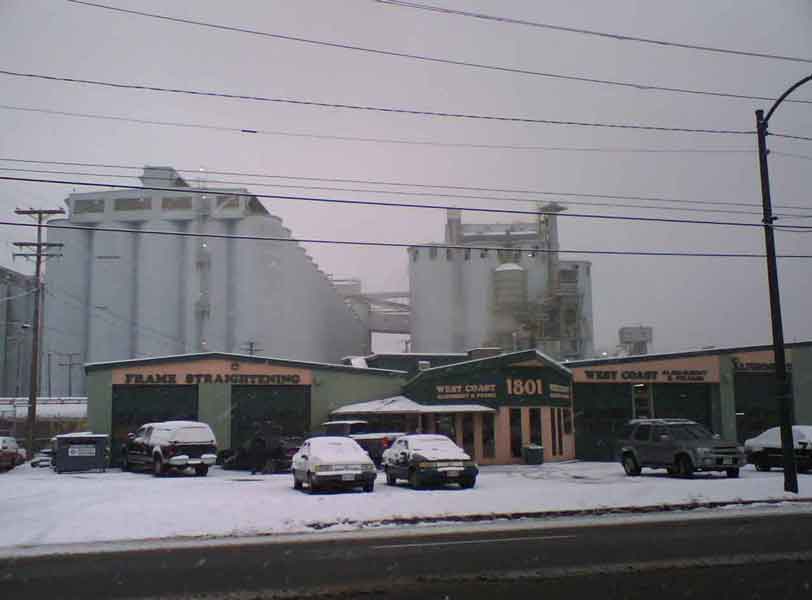
The area surrounding the JJ Bean roasting facility at the intersection of
Powell St. and Victoria Drive in East Vancouver is notable for an
abundance of industry. Within a radius of a few city blocks can be
found a chicken rendering plant, a fish products rendering plant, an
asphalt manufacturing facility, the now defunct Terminal City Iron
Works (recently converted into a post-apocalyptic film set) the
Canadian Pacific Railway, the Port of Vancouver, and many smaller
businesses selling automotive parts, self-storage and scrap metal.
There are a half-dozen single family homes up the street on Victoria
Drive, several of which are adorned with “for sale” signs.
In his letter to the Islands Trust, Mr. Grams asserts that, in the
context of the City of Vancouver, “unless it can be clearly shown that
smoke and smell are a pervasive issue, then the Environmental Impact
Assessment, which confirms that neither pollution nor smoke nor smell
should be a concern, must be regarded as the defining document.”
At this time, there is little evidence to suggest that emissions from
coffee roasting are a “pervasive problem” throughout the City.
However, one cannot take this fact at face value: Vancouver has a
well-developed and rigorously enforced policy of keeping all potentially
harmful and/or obnoxious industrial activities at a safe distance from
residential areas.
In the City of Vancouver, coffee roasting is defined according to the
Zoning and Development By-law (Section II; p. 7) as “Food Products
Manufacturing.” According to Mahbod Biazi, a Development Officer at
City Hall, this definition requires all coffee roasting activity (excepting
in-store small batch roasting in commercial areas) to be confined to
sectors of the city which have been set aside for industry, protected
from residential neighbourhoods by major urban infrastructure such as
parks and highways, geographic features such as waterways, and
commercial “buffer zones.” The question of whether or not there are
disagreeable emissions from modern roasting facilities such as the one
proposed by the applicant and currently operated by JJ Bean is thus
largely solved in Vancouver without too much controversy.
A development of the proposed type in the Ford Lake area on Salt
Spring Island would not be permitted in the City of Vancouver.
Emissions
“[The EIA] makes no mention of the frequency of complaints
due to coffee so we can make no assessment as to whether
or not it was an issue in the areas studied. Our suggestion,
namely that the Island’s Trust contact Vancouver to
determine if this is a ubiquitous problem, is still the most
valid means to assess this as potential grounds for refusal.”
As evidenced in the preceding passage contained in Mr. Grams’ letter,
the Applicant is of the opinion that because the EIA contains no
information concerning complaints from residents in the vicinity of
coffee roasting facilities in Vancouver, then consequently unpleasant
emissions do not amount to a “pervasive problem.” Notwithstanding
Mr. Grams’ consistent reliance on circular reasoning to argue his case,
this report finds that, at least within the mainly industrial area
surrounding the JJ Bean facility, there have been several complaints by
neighbours about the unpleasant smell of roasting coffee which have
not only prompted JJ Bean to make difficult choices in the operation of
their emissions control equipment, but also to purchase more
environmentally friendly equipment even as they sell off the old plant
to the Applicant.
In modern coffee roasting, the release of unpleasant and dangerous
vapours is limited by the installation of an “afterburner”—essentially a
natural gas burning furnace located within the main smokestack—
which, when running reliably and turned up to maximum heat is
capable of burning off a significant portion of emissions.
Citing their own EIA as well as a report the afterburner manufacturer,
the Applicant suggests that thanks to this technology, emissions will
be negligible.
On the ground, however, the situation is more complicated. According
to David Long, chief roaster and manager of JJ Beans’ wholesale
department, reducing emissions from the coffee roasting itself comes
with a heavy financial and environmental price.
“We received a call from the City about eight months ago.
They informed us that there had been some complaints in the
neighbourhood about the smell of roasting coffee. I was a
little surprised, considering how pervasive the smell from the
chicken rendering plant can be. The city said we needed to
reduce our emissions, and the only way to do that is to
increase the temperature of our afterburner from 500 C to a
little over 600 C. I don’t pay the bills, but I can tell you that it
massively increases our consumption of natural gas—more
than enough to heat houses in winter—and significantly
increases our environmental footprint. At the end of the day,
you are left with a choice. What do you want: odors or a
bigger carbon footprint?”
He added that JJ Bean was in the process of acquiring a new
afterburner, equipped with a computer controlled timing system
capable
of regulating the temperature inside the burner.
He explainedthat the first fifteen minutes of the twenty minute roasting process
create much less smoke and odour than do the final five minutes. The
new machine accommodates this discrepancy by automatically raising
and lowering the temperatures over the course of the roasting,
thereby increasing fuel efficiency. Long also noted that the old
afterburner, which they are selling to the Salt Spring Coffee Co., is not
equipped with such a mechanism.
In addition to such concerns over the operation of the afterburner
itself, Mr. Long outlined several related emissions problems.
The afterburner is located just below the smokestack, and is therefore
most effective when it is burning off the heated gases and particulate
emanating directly up from the main roasting oven. In the facility that
is being sold to the Applicant, several other pipes that do not ascend
vertically into the afterburner ventilate the main oven and other
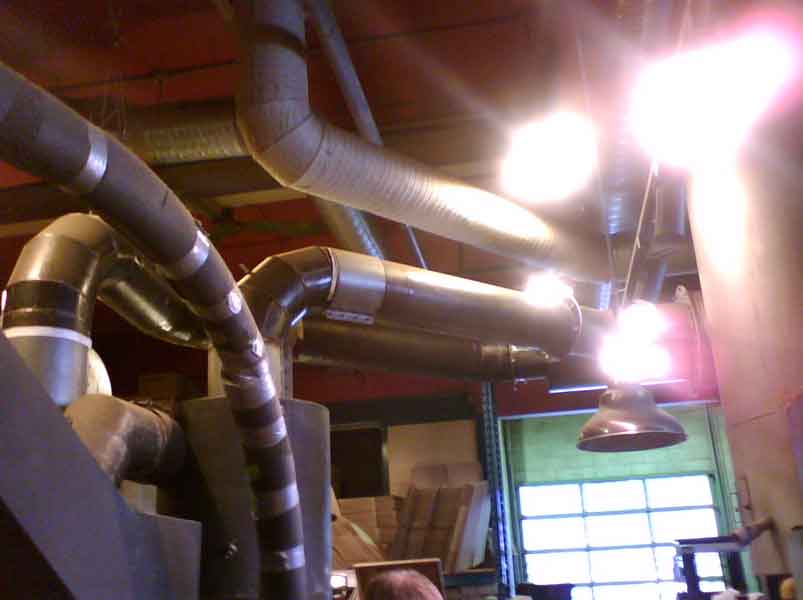
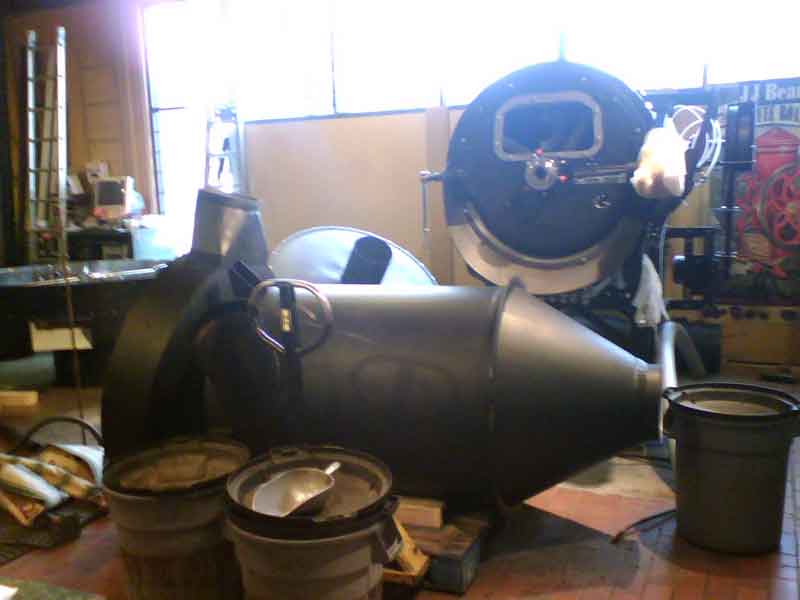
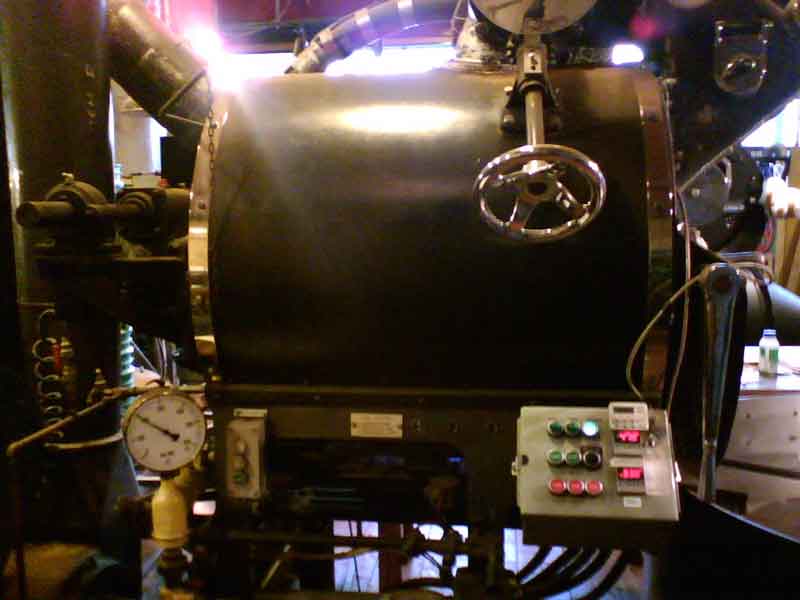
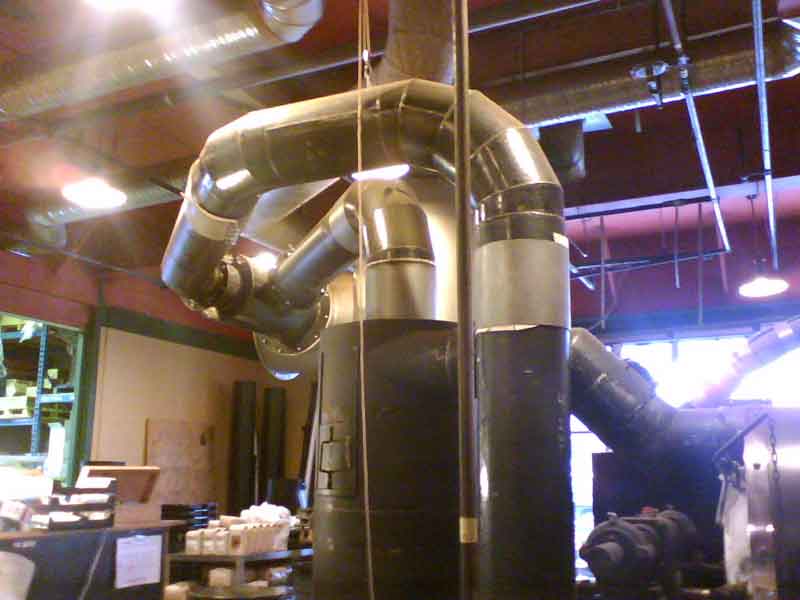
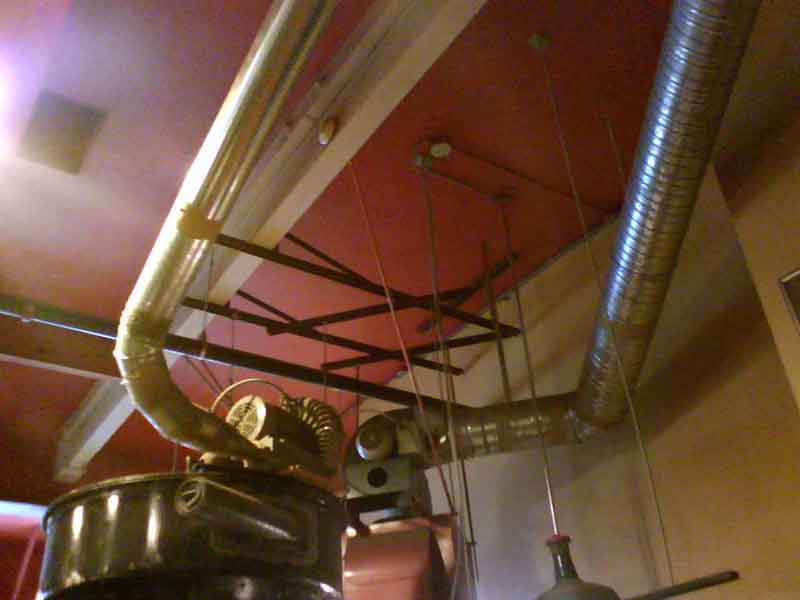
features of the roasting machine. The result is a forest of pipes
carrying unburnt emissions laterally across the factory ceiling. Even if
well maintained, lateral pipes tend to release unburnt smoke directly
into the environment, and when they are old and patched like those
pictured in the attached photographs, they can end up responsible for
a significant portion of emissions.
Conclusion
Given the status and performance of the equipment that is being sold
to the Applicant, the issue of emissions at the proposed Fulford-
Ganges Rd. development comes down to one simple choice: do you
want to be clean or green?
If the reality of the roasting process is that the roaster must decide
between unpleasant emissions and massively increased fuel
consumption and its associated costs (transport onto the island,
greater environmental footprint from burning fossil fuels etc.), then it
seems clear that the Applicant would be best served by following the
example set by the City of Vancouver. If the proposed roasting facility
were to be built in an industrial area separated from residential
neighbourhoods and environmentally sensitive areas such as Ford
Lake, then the Applicant could operate the facility more responsibly,
using less natural gas without constantly worrying that roasting
emissions
were negatively affecting its neighbours.